
WGF Recommendations for the North Central Forest Draft Regional Master Plan
Wisconsin's Green Fire, December 15, 2025

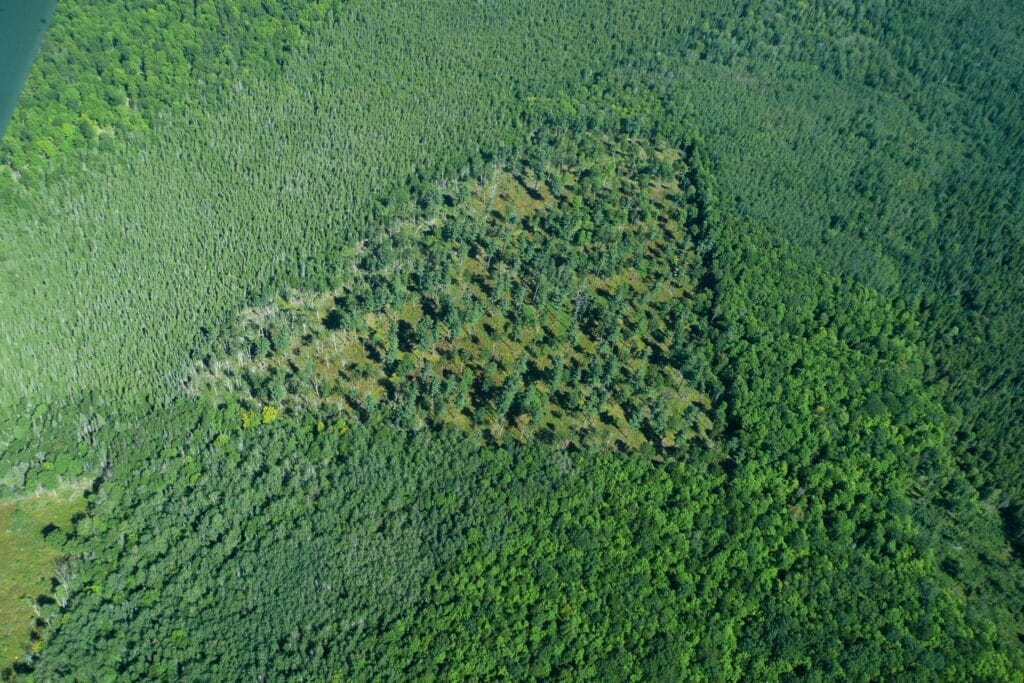
Old growth white pine shelterwood, Board of Commissioners of Public Land, 40 acres east of Upper Post Lake, Langlade County. Photo by Ron Eckstein.
WGF Recommendations for the North Central Forest Draft Regional Master Plan
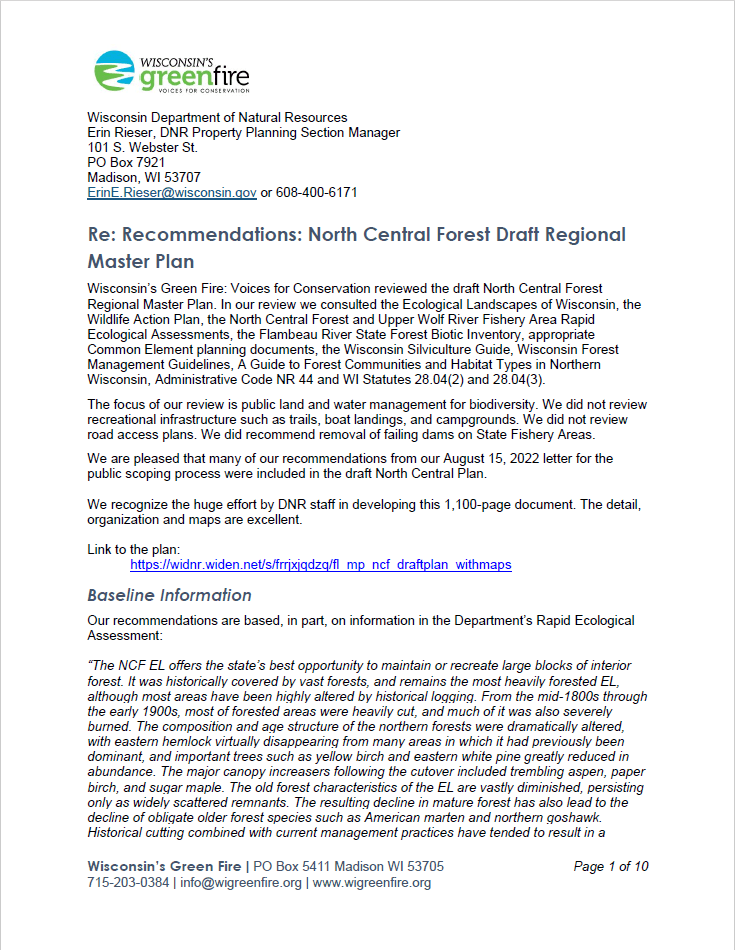
WGF Recommendations: North Central Forest Draft Regional Master Plan, Dec. 3, 2025, p.1.
In early December 2025, Wisconsin’s Green Fire (WGF) submitted a detailed set of recommendations to the Wisconsin Department of Natural Resources (WDNR) on the North Central Forest Draft Regional Master Plan.
In our review, we focused on public land and water management for biodiversity. These topics are at the core of our mission and strategic conservation priorities.
The subject-matter experts on our Public Lands and Forestry Work Group, chaired by Ron Eckstein, prepared these recommendations. Offering our technical expertise and recommendations like this is one of our strengths as an organization. We’re proud to provide this kind of public input to the WDNR’s process in managing these public resources in Wisconsin.
What is the North Central Forest Draft Regional Master Plan?
All properties managed by the WDNR are required to have master plans that describe their authorized uses and management. Usually, these plans cover a 15-year time period. The plans are developed by teams of staff across the WDNR with public input (state statute requires this). These Master Plans are developed for different regions around Wisconsin based on different ecological landscapes. These regions are characterized by patterns in their soils, waters, habitats, plant and animal communities, and other features.
The North Central Forest Draft Regional Master Plan is an 1,118 page document. It describes the plans for over 217,000 acres of WDNR-managed lands in the North Central Forest region. These include scenic waters, state fishery areas, public access sites, state forest lands, state natural areas, state wildlife areas, national and state trails, and other sites. While the master plan includes detailed and important information about both ecological and recreational aspects of management, our recommendations did not delve into the recreational parts.

Ecological Landscapes of Wisconsin Map
North Central Forest At-A-Glance
The following information comes from the North Central Forests chapter of the Ecological Landscapes of Wisconsin. These chapters are a compendium of ecological, social, and economic information about Wisconsin’s 16 distinct ecological landscapes. Each chapter is packed with facts, photos, and maps. They are available for purchase in hard-copy here, or viewable online here. (Note: WGF receives a portion of proceeds from print purchases of the Ecological Landscapes of Wisconsin.)
Citation: Wisconsin Department of Natural Resources. 2015. The ecological landscapes of Wisconsin: An assessment of ecological resources and a guide to planning sustainable management. Chapter 12, North Central Forest Ecological Landscape. Wisconsin Department of Natural Resources, PUB-SS-1131N 2015, Madison.
The region has “the best large-scale interior forest management opportunities in the state.” The North Central Forest has “excellent opportunities to manage areas for older forest within a context of outstanding aquatic features, intact and relatively undisturbed wetlands, and vast forested public landholdings.” Forests cover approximately 75% of the land in the North Central Forest. The region is 6,107,516 acres in size (9,543 square miles), about 17% of the area of Wisconsin. The public owns about 42% of the region’s lands as federal, state, or county lands.
Overview of WGF’s Recommendations in 2025
The following points are excerpts from our recommendations to the October 2025 draft master plan for the North Central Forest. Please read the full set of recommendations for more details. Contact us with questions or comments of your own. We encourage members of the public to be actively involved in giving input to the WDNR and other public agencies about managing our natural resources.
WGF Areas of Support
- We are pleased that many of our recommendations from our August 15, 2022 letter for the public scoping process were included in the draft North Central Plan.
- Integration. Use an integrated team (Wildlife, Natural Heritage, Forestry, Fisheries, Parks) to plan and implement land and water management.
- Inventories. Conduct a Biotic Inventory/Rapid Ecological Assessment for large properties of groups of small properties that lack this analysis.
- Species of Greatest Conservation Need. We support management to protect habitat and increase populations of Species of Greatest Conservation Need (97 animal and 74 plant species) as well as state and federal endangered and threatened species.
- Areas of Special Conservation Interest, pages 536 – 547. To the extent possible, we support management to protect and enhance habitat on all the Conservation Opportunity Areas, Primary Sites, Important Bird Areas, Important Water Resources (Outstanding and Exceptional Waters, Trout Waters), the 10 Wetland Gems identified by the Wisconsin Wetlands Association, and Areas of Special Natural Resource Interest.
- DNR Public Land Portfolio. We fully support the plan’s expansion of state-owned lands: 58,682 acres of boundary expansion including an additional 21,543 acres of acquisition authority within the boundaries. This effort will help bring state-owned properties up their full potential for public recreation, economic development and the conservation of resources.
- Public Land Boundary and Management Designations. We support several expansions (details here) and preferred alternatives related to specific state natural areas, fishery areas, wildlife areas, state forests, and trails.
- Flexible Active Resource Management Alternative. We support the Flexible Active Resource Management Alternative with resource management decisions being made using integrated teams from Wildlife, Forestry, Fisheries, Parks, and Natural Heritage Conservation.
- Wild Rice Resources. We support increased management to protect and restore wild rice.
- Climate. We support increased efforts to manage natural resources in ways that address a changing climate and help sequester carbon in vegetation and soils.
WGF Recommendations
- Prescribed Fire. Prescribed fire is an important management tool. We recommend adding a section in the plan on the benefits prescribed fire and adding an active prescribed fire regime to the management options for appropriate wildlife areas, parks, natural areas and recreation areas.
- Tribal Resources, pages 18, 556 -557. The department must make all efforts to coordinate and cooperate with tribal nations in the North Central Forest Ecological Landscape.
- Property Planning Common Element Documents. We recommend property managers follow these management guidelines.
- Composition & Structure. A general concept is that terrestrial vertebrate wildlife diversity increases in forests that have high tree species diversity (composition) and high vegetative complexity (structure).
- Irregular Shelterwood and Ecological Silviculture. We recommend incorporating these concepts in property management.
- Snags and Cavity/Den Trees. While it is a good practice to maintain snags, it is a much better strategy to maintain large-diameter live trees that have current and future cavity/dens.
- Reserve and Legacy Trees. A very important consideration for plant and animal diversity is applying legacy and reserve management. Guidelines for legacy and reserve trees are found in chapters of the Wisconsin Silviculture Guide, the Wildlife Action Plan, and many Species Management Plans.
- Eastern Hemlock, Yellow Birch, and White Cedar. Expand their distribution and abundance and manage existing stands for old growth characteristics.
- White Pine. We emphasize paying particular attention to management of white pine. We recommend maintaining existing white pine trees throughout northern hardwood, oak and aspen forests and managing individual trees and stands for old growth characteristics.
- Northern Hardwoods. Diversify northern hardwood stands. Many northern hardwood stands are relatively young, even-aged, and lack tree species diversity and a complex vegetative structure.
- Aspen. Diversify aspen stands. We recommend managing for mature reserve and legacy trees such as white pine, eastern hemlock, white spruce, red oak and white oak.
- Oak. Maintain and Regenerate Red and White Oak Stands. Many oak-dominated stands are about 85 years old and managers are applying two-stage shelterwood silviculture. There are many reports of failure to regenerate oak due to deer browsing and competition from maple stump sprouts and ironwood. All efforts must be made to regenerate oak stands to oak.
- Ephemeral Ponds. Ephemeral ponds (vernal pools) are important habitats in forest landscapes. They are especially common on Flambeau River State Forest. We recommend procedures to keep logging equipment from entering ephemeral ponds.
Turtle Flambeau Flowage Scenic Waters Area, pages 37 – 74
We support specific boundary expansions and resignations (details here). To the degree feasible and practicable, we recommend to design and conduct timber and other management activities to maintain and enhance an attractive, natural-appearing landscape. In particular, we support management of individual trees and stands of white pine, eastern hemlock and white cedar for old-growth characteristics and passive management of these forest types where appropriate. We also support retention and extension of the Quiet Area.
State Fishery Areas and Aquatic Resources, pages 75 – 155
We support the management objectives and prescriptions for the fishery areas in the North Central Forest Ecological Landscape, as listed. These objectives and the proposed prescriptions are based on sound ecological principles. An important concept reiterated in the objectives is the connectivity of aquatic and semi-aquatic habitats: streams, lakes, wetlands and riparian areas. We support the expansion of existing fisheries area properties or boundaries through land acquisition. We support the Brook Trout Reserves Easement Program designed to conserve and protect brook trout populations from changing environmental conditions through the acquisition of potential easements by the department.
Several prescriptions in this plan address the management of impoundments created by beavers and dams built and maintained by humans. dams on small streams can be vestiges of former mills and logging operations and no longer serve a useful function. Such impoundments should be removed as appropriate to reconnect streams and lakes, providing free movement of fish and other aquatic organisms.
We recommend the removal of abandoned or failing dams on state fishery areas.
Staff and Funding
We understand that successful implementation of the North Central Forest Regional Plan will require additional staff and funding. This will require the State Legislature to enact laws and authorities to secure staff and funding.
Learn More
- Read WGF’s recommendations for the North Central Forest Draft Regional Master Plan here [PDF].
- Browse previous blog posts from WGF related to Public Lands and Forestry.
- Read WGF’s 2024 publication or watch the webinar on Wisconsin Forests at Risk.
- View regional master plans for all of Wisconsin from the WDNR.
- Contact WGF with your questions or concerns.